
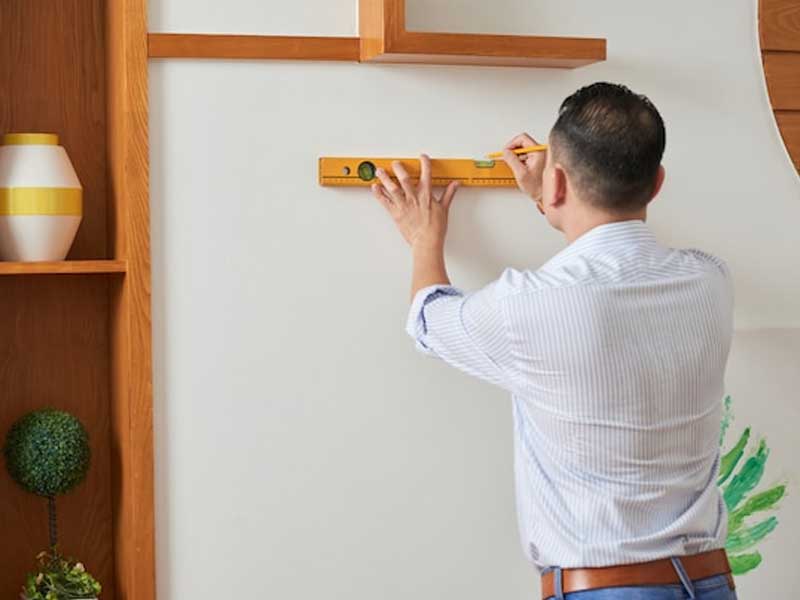
Hanging pictures and fitting shelves seems easy until you stand there with a drill, uncertain about what’s behind the wall or if your fixings will hold. The wrong approach leads to fallen frames, cracked plaster, and sagging shelves. Getting it right means knowing wall types, choosing fixings, and positioning everything level and secure. A Handy Hand provides professional picture hanging and shelf installation across Enfield, Barnet, Haringey and throughout North London. From single heavy mirrors to complete gallery walls, from floating shelves to alcove units, we handle the jobs that seem straightforward but benefit from experience and proper tools. Your walls stay intact, your pictures stay up, and your shelves stay level. Contact us today to book your installation and enjoy peace of mind.
Call us on 020 8103 5151 for a free quote.
We offer expert hanging of pictures, mirrors, artwork, and decorative items of all sizes and weights. Whether you’ve just moved in and need everything hung at once, or you have a single special piece that deserves professional attention, we ensure precise, secure results that protect both your walls and your belongings. Our clients trust us for our reliability and tailored approach. Standard picture-hanging covers frame prints, photos, canvases, and lighter decor. We pick the fixings for your wall and the item’s weight, hang frames at the right height, and ensure the results are level. For multiples, we plan layouts before drilling. Heavy items hanging need stronger fixings and care. Large mirrors, oversized artwork, and heavy frames use rated fixings, placed in solid material or spread across several points. We use anchors, toggles, or direct fixings, depending on the wall type.
Gallery wall installations arrange multiple frames into cohesive displays. We plan layouts on paper first, establish consistent spacing and alignment, and hang everything level. Gallery walls look effortless when done well, but require careful measurement and planning to achieve that effect.
Mirrors present particular challenges due to their weight and the consequences of failure. A fallen mirror risks injury, seven years of bad luck aside, and damage to floors, furniture, and the mirror itself. Professional hanging provides peace of mind that your mirror is secure.
Small to medium mirrors with D rings or wire backs hang using standard heavy-duty picture fixings, scaled appropriately for the weight. We check that existing hardware is secure and replace any worn or inadequate components. Large, heavy mirrors often require several fixing points to share the weight. French cleats support large mirrors by spreading the load and allowing precise positioning. For very heavy pieces, we may recommend mirror clips or rails.
Bathroom mirrors require consideration of moisture and the likelihood of tile rather than plasterboard surrounds. We use appropriate fixings for tiled walls and ensure any electrical connections for illuminated mirrors are handled safely.
Leaning mirrors that rest on the floor still benefit from wall anchoring to prevent toppling. A simple safety fixing at the top prevents accidents without detracting from the casual leaning look.
Shelves need to support their intended load without sagging, pulling away from walls, or collapsing entirely. Proper installation means choosing the right shelf system for the purpose, locating fixings in solid material where possible, and ensuring level, secure results.
Floating shelves create a clean, modern look with no visible brackets. These rely on concealed internal supports or mounting plates that transfer load into the wall. Success depends on hitting studs, using appropriate plasterboard fixings, and ensuring the shelf mechanism can handle the intended loads. We advise on realistic weight limits for different floating shelf systems.
Bracket shelves use visible supports beneath the shelf surface. Traditional metal or decorative brackets remain popular for their reliability and load capacity. We fit brackets at the appropriate spacing for shelf length and secured them into solid fixings.
Adjustable shelving systems with wall-mounted uprights and movable brackets suit areas where flexibility matters. Bookcases, pantries, and storage rooms benefit from systems that can reconfigure as needs change. We install tracks, plumb, and level for smooth bracket adjustment.
Alcove shelving makes use of the recessed spaces beside chimney breasts common in Victorian and Edwardian homes. Shelves spanning between walls can use battens, brackets, or a combination of both. We measure carefully for an accurate fit and ensure shelves are level despite walls that rarely are.
North London properties feature various wall constructions, and understanding what you’re fixing into determines success or failure. Different walls require different approaches, and getting this wrong can cause problems.
Solid brick or block walls, common in Victorian, Edwardian, and interwar properties, provide excellent holding power for appropriate fixings. Masonry anchors and wall plugs grip securely in solid material. These walls forgive slightly imprecise drilling positions since you’re always hitting solid material.
Plasterboard on timber studs, standard in modern construction and common in extensions and conversions, requires a more careful approach. Heavy items need to be fixed to the timber studs behind the board. Lighter items can use specialist plasterboard fixings that spread the load across the board area. Finding studs matters for substantial loads. Plasterboard on dabs attaches to masonry with adhesive, not studs. The board sits off the wall, so use longer fixings to reach the masonry. Fixing only to plasterboard gives little support.
Lath and plaster, found in older properties before plasterboard became standard, consists of timber laths covered in lime plaster. This material drills differently and needs appropriate fixings. Heavy items should be located on studs rather than relying solely on lath.
Partition walls divide spaces within properties and may be solid or hollow depending on age and construction method. We assess each wall before drilling to ensure appropriate fixings for the actual construction.
Fixings fail when they’re wrong for the wall type or underrated for the load. We carry a range of fixings for different situations and select appropriately rather than forcing one solution onto every problem.
Standard wall plugs and screws suit solid masonry for most picture hanging and lighter shelf loads. Quality plugs in correctly sized holes provide reliable performance for typical domestic applications.
Heavy-duty anchors handle substantial loads in solid walls. Resin anchors, expanding bolts, and specialist heavy-duty plugs support large mirrors, laden bookshelves, and other demanding applications.
Plasterboard fixings come in various types for different loads. Spring toggles, gravity toggles, and metal cavity fixings all have their place. We match the fixing type to the load requirement and board thickness.
Direct screw fixings into timber studs provide the strongest hold in stud walls. For heavy items, locating studs and fixing directly into the timber outperforms hollow-wall anchors.
Adhesive fixings suit situations where drilling is impossible or undesirable. Quality adhesive hooks and strips handle lighter items reliably, though we’re honest about their limitations for heavier loads.
Gallery walls group multiple pictures into cohesive displays that make more impact than individual scattered frames. Creating these arrangements requires planning, consistent spacing, and careful execution.
We start by laying out arrangements on the floor or using paper templates on the wall. This lets you see the overall effect and make adjustments before any holes are drilled. Shuffling physical frames or paper cutouts is much easier than moving drilled fixings.
Grid arrangements align frames in regular rows and columns. This formal approach suits matching frames and works well with furniture like sofas or sideboards. Precise measurement ensures the geometric effect is clearly visible.
Salon-style arrangements cluster frames of different sizes into more organic groupings. These need careful balance, with larger pieces anchoring smaller ones around them. The casual look requires more planning than it suggests.
Staircase arrangements follow the angle of stairs, either as a single ascending line or grouped displays that step up with the stairwell. Getting angles and spacing right while climbing ladders requires experience.
We measure and mark all positions before drilling, double-check levels across multiple points, and hang everything systematically. The result looks effortless precisely because it wasn’t.
Wall-mounted televisions free up floor space and create a cleaner look than traditional stands. Proper mounting ensures your expensive screen stays secure and sits at comfortable viewing angles.
Fixed mounts hold televisions flat against walls at set positions. These suit locations are where you always view from the same spot and want the slimmest possible profile.
Tilting mounts allow vertical angle adjustment, useful when mounting above eye level or accommodating different seating positions. The television stays flat to the wall but can angle down toward viewers.
Full motion mounts extend from walls and allow adjustment in multiple directions. These suit corner positions, rooms with multiple viewing areas, or situations where the screen needs to pull out and angle significantly.
We assess wall construction before mounting, select appropriate fixings for the television’s weight and mount type, and ensure secure attachment. Cable management options hide wires for a cleaner appearance, either through surface trunking or, where feasible, routing within walls.
Our service focuses on picture hanging, standard shelving, and television mounting rather than extensive fitted furniture or structural work.
Built-in wardrobes and fitted bedroom furniture need specialist fitters with specific skills and often bespoke manufacturing. We recommend dedicated fitted furniture companies for these projects.
Extensive alcove units with doors, drawers, and complex configurations fall outside our scope. Simple alcove shelves we handle happily, but full fitted units need joiners or fitted furniture specialists.
Structural shelving or storage affecting load-bearing walls requires proper assessment and potentially building control involvement. We fit shelve